It's been 3 years of building this car, including a house move and some extended time abroad for work, but I yesterday I finally got it through the IVA test.
This pretty much signifies the end of the build although there may be a few 'tweaks' yet to be applied.
The first test was in the middle of August. I shan't go in to a lot of detail but I shall say it went fairly well. It took 2 hours to find anything wrong and then only really minor problems that wouldn't take a lot of time or effort to rectify. There was one slightly more significant issue regarding the Speedometer which required a bit more attention.
Here's what it failed on:
Radiused edges around the seat belt mounts, gear stick gaiter surround, steering wheel, and front suspension mounts. Trim applied to satisfy the requirements.
The ECU could also be reached from the passenger side seat position so needed a cover.
Collapsible steering assembly. The boss the steering wheel is mounted on needs to be collapsible. The one fitted was not so I had to get a new one. Also for the steering column itself, it wasn't obvious how it would collapse in the event of a front impact. This required a little research and advice from Richard at GBS.
The problem with the Speedo was interesting. At 70 mph and above the needle would flick around all over the place, clearly something wrong there. It turned out to the the sensor not mounted squarely to the prop shaft. I remade the bracket so it was.
Other than that the inspector was quite complementary about the build of the car in general.
Three weeks later I took the car on it's first road journey to the test center for a retest. This took less than 20 minutes, and I was issued with an IVA pass certificate.
So, that's pretty much the end of the project... Only the registration to do and fit the number plates. I hope we get at least a couple of days of good weather in the next couple of months!
I'll continue to update this blog as and when I take the car out or do anything to it.
This is the build diary of my GBS Zero kit car, a 2 seat Lotus 7 style sports car that uses a Mazda MX-5 as a parts donor. I am doing this ‘blog’ to add another aspect to the project which will hopefully help me keep focused and provide a useful reference for future projects and anyone interested in kit cars. Comments and questions welcome.
Saturday, 3 September 2016
Monday, 8 August 2016
Update
Well, I could real off a list of excuses as to why I haven't updated the blog recently but they are, as I say, excuses. Here's a quick update anyway:
The car is basically finished and I am waiting to take it in for it's IVA test in a few days time. Here's a few pictures of the (almost) completed car both outside my old flat and in front of the Instant Garage on my patio.
I had attached the wheels and enough running gear to be able to move the car from the garage under my old flat to my new house. Here it was waiting for the transporter to arrive.
After a few very hot days in the instant garage, the glue on the carpets on melted. I had to take the seats out to put it all back again.
I'm really pleased with the dashboard. The modern gauges hint at the newer engine and electronics than the classic sports car styling suggests.
I will endeavour to post a few more photos after the IVA test if I haven't been battered too much.
Sunday, 25 October 2015
Onwards...
And again, I neglect the Blog. My apologies. And I must also report that a significant amount has happened in the time since the previous post in March, the most significant of which is that I have moved house and spent most of the summer renovating it. This has left the car a little neglected, but before I moved, I had to get the car in to a state where but I could move it as well.
Previously I had succeeded in getting the engine started. It runs well, albeit a bit rich, which is a great relief. Due to limited space in the garage I had built all the parts of the car such as suspension, brakes, nose etc. separately, fitted them, then removed everything ready for a final assembly at the point I could move the car.
I realise this this is going to miss out a fair amount of actual work which I have not had time to commit to words, but at end of May I finally got to the point of needing to move the car from the garage under the flat to my new place. As per the plan, the parts were duly fetched from all corners of the flat and one by one bolted to the chassis.
I wanted to fit the seats so I could drive it out of the garage which meant fitting the carpets as I didn’t want to remove the seats again. I had already cut the carpet for the rear panel and side of the tunnel, as well as covering the panels for the top of the tunnel so these when in fairly easily.
I then needed to get it down on to its wheels. Less said about this the better really, but I used to engine hoist attached to the centre of the chassis to lift it off the trestles and on to the ground. It worked, but I hope I don’t have to do it again…
Obviously I can’t drive the car on the road yet so I booked a tow truck to put it on. The time had come to drive it for the first time. Just a short journey out of the garage, on to the waiting truck, and off again at the house.
First impressions: Brilliant! This is going to be a lot of fun to drive. I’ve got a load of trim to finish and various things to complete for the IVA but realistically this is not going to happen this year. I shall look forward to getting it on the road in the Spring.
Previously I had succeeded in getting the engine started. It runs well, albeit a bit rich, which is a great relief. Due to limited space in the garage I had built all the parts of the car such as suspension, brakes, nose etc. separately, fitted them, then removed everything ready for a final assembly at the point I could move the car.
I realise this this is going to miss out a fair amount of actual work which I have not had time to commit to words, but at end of May I finally got to the point of needing to move the car from the garage under the flat to my new place. As per the plan, the parts were duly fetched from all corners of the flat and one by one bolted to the chassis.
![]() |
| Fitting the Suspension |
I wanted to fit the seats so I could drive it out of the garage which meant fitting the carpets as I didn’t want to remove the seats again. I had already cut the carpet for the rear panel and side of the tunnel, as well as covering the panels for the top of the tunnel so these when in fairly easily.
![]() |
| Carpets Fitted |
I then needed to get it down on to its wheels. Less said about this the better really, but I used to engine hoist attached to the centre of the chassis to lift it off the trestles and on to the ground. It worked, but I hope I don’t have to do it again…
Obviously I can’t drive the car on the road yet so I booked a tow truck to put it on. The time had come to drive it for the first time. Just a short journey out of the garage, on to the waiting truck, and off again at the house.
So, there’s no proper garage at the new place yet so I’ve invested
in an “Instant Garage” to house the car for the time being.
Sunday, 8 March 2015
Engine Starting
And again I leave this Blog neglected for too long.
A lot has happened which I will commit to words in the next few weeks, but right now I can report that a major milestone has been reached - I have successfully started the engine!
It doesn't sound like much, and really it should be a formality, but considering this engine hasn't run for almost 2 years, it has a whole new wiring loom, new ECU, new fuel system and throttles, it's not a bad achievement.
More updates to follow as I have got a bit further with the build.
Monday, 1 December 2014
Panel Beating
I suspect, when I finish this project, people will ask what the worst or most difficult part of the build was. Well, at this stage I would like to submit "fitting the rear panel" as the biggest pain in the proverbial back side to bestow my time in the garage with this car.
After a couple of days trying to get it to look right, and some more help from my brother, I think we've make a reasonable job if it. At the moment the chassis is sitting on a couple of trestles to raise it to a workable height so the imperfections in the bends are visible, but when it it on the ground and the trim is in place it shouldn't be so obvious.
It should be simple. The panel comes pre-cut and with two right angle bends for attachment to the underside of the chassis and to the supports from the roll bar. What is required is two curved bends of about a 3 inch radius to form the corners around the small boot space. This presents the first problem as, due to the existing bends, it is not possible to bend the sides past the 90 degrees needed to form the curves. Well I can't do it anyway.
After a couple of days trying to get it to look right, and some more help from my brother, I think we've make a reasonable job if it. At the moment the chassis is sitting on a couple of trestles to raise it to a workable height so the imperfections in the bends are visible, but when it it on the ground and the trim is in place it shouldn't be so obvious.
Next job, fitting it. Again, should be straight forward, there are defined points to attach the panel to the car, and its clear where it should fit. Along the sides it should line up neatly over the wheel arches, and at the back it attaches to the supports from the roll bar and to the underneath of the chassis. No matter how I offered it up to the chassis, the panel was either too far forward of the wheel arches when the roll bar supports lined up, or too far back from the supports when it lined up with the wheel arches.
The answer as it turned out was painfully simple. It seems that somewhere in the manufacturing process there is a tendency for the supports to dip down slightly. GBS say they haven't workout out how and why this happens but it is safe to bend the supports up slightly to make the panel fit. I'd already worked this out by the time I spoke to them but it was good to have it confirmed.
In case you are concerned about bending said supports, I used the logic that if the welds broke I probably wouldn't want to drive the car anyway.
At last it fits. I've now attached it with rivets and adhesive so it's really not going anywhere. There is a thin bead of piping trim that runs between the rear panel and the top shroud. This was a little tricky to get right, but after spending some time getting the bends neat, it actually looks pretty good (as long as you don't look too closely at the bends in the panel underneath it).
Monday, 24 November 2014
Electrics
I decided to try to save a bit of money by doing the wiring for the car myself. This sounded like a simple enough idea as this is after all a fairly small and simple car. I am re-using the steering column from the MX-5 so the switches for the headlights, indicators, and windscreen wipers will be incorporated in to the new loom.
Starting at the back I have a loom that incorporates the brake, indicator, reverse, fog, and tail lights, along with the fuel level sender. This is wired back the the fuses and relays mounted on the engine side of the firewall.
The loom that runs to the front of the car connects the headlights, indicators, fan, and horn. These are all terminated on connector blocks ready to be linked to the lights when installed. The engine obviously requires a lot of wiring, but this will be kept separate.
The stalk switches from the MX-5 Steering column are wired to a junction box under the passenger foot well. These will control the headlights, indicators, and wipers.
There's a lot more to this wiring business than you might think. For example, the indicators also have to act as hazard lights. The hazards need to be able to flash with the ignition switched off, and the indicators should only work with the ignition on. There also needs to be an indication on the dashboard when the hazard lights are active, so there needs to be two separate flasher units, one each for the indicators, and the hazards.
It's been a little difficult to check the wiring with no lights connected but I have managed to test some of them and I am pleased to say that so far all have work as planned. The indicators can only be seen so far on the lights on the dashboard and I don't think there is quite enough load for the flasher units to work properly so the lights just fade on and off. Hopefully that will be resolved when I connect the exterior lights.
The dashboard is now more or less finished. I've wired it on an extra length of cable so to enable the whole panel to be removed and allow access to the wiring and ECU attached to the firewall.
That's where it is at the moment. Rear panel to do, and get some lights on.
Starting at the back I have a loom that incorporates the brake, indicator, reverse, fog, and tail lights, along with the fuel level sender. This is wired back the the fuses and relays mounted on the engine side of the firewall.
The loom that runs to the front of the car connects the headlights, indicators, fan, and horn. These are all terminated on connector blocks ready to be linked to the lights when installed. The engine obviously requires a lot of wiring, but this will be kept separate.
The stalk switches from the MX-5 Steering column are wired to a junction box under the passenger foot well. These will control the headlights, indicators, and wipers.
There's a lot more to this wiring business than you might think. For example, the indicators also have to act as hazard lights. The hazards need to be able to flash with the ignition switched off, and the indicators should only work with the ignition on. There also needs to be an indication on the dashboard when the hazard lights are active, so there needs to be two separate flasher units, one each for the indicators, and the hazards.
It's been a little difficult to check the wiring with no lights connected but I have managed to test some of them and I am pleased to say that so far all have work as planned. The indicators can only be seen so far on the lights on the dashboard and I don't think there is quite enough load for the flasher units to work properly so the lights just fade on and off. Hopefully that will be resolved when I connect the exterior lights.
The dashboard is now more or less finished. I've wired it on an extra length of cable so to enable the whole panel to be removed and allow access to the wiring and ECU attached to the firewall.
That's where it is at the moment. Rear panel to do, and get some lights on.
Sunday, 12 October 2014
Back in the Garage
I can't believe it's been 5 months since my last post on this blog. It's not that nothing is happening, just for some reason I haven't managed to convey work to writing. I am still contributing to the Complete Kit Car magazine Running Reports feature which I would recommend for anyone interested in understanding what it is really like to build a kit or one-off car.
For the people who tell me, or at least I hear about, who are looking at this blog to see how the car is getting on, sorry for leaving you in the dark! Let get you up to date...
There are two main sections that have had concentrated effort since I last wrote - Brakes and Wiring. Lets start with Brakes now and I'll do wiring in a few days.
For some time I have resisted putting the brakes on the car. The limited space in the garage means that with the brakes fitted there will very little room to move around the car to do other work. Unfortunately I got to a point where I could not carry on until I had the brakes fitted and knew the pipework was good and didn't need anymore work. I already had the rear suspension and drive shafts fitted so it makes sense to fit the rear brakes on the uprights, the front ones however can be attached to the pipework and bled, and left tied up to the front shock absorber mounts.
The brakes are the original Mazda MX-5 brakes. I have stripped the front ones down, sandblasted them, and panted them (roughly) the same colour as the GRP nosecone and wheel arches will be. The rear ones were not so easy as they contain an over-complicated self-adjusting mechanism for the handbrake - more on that later.
With the help of my brother (OK to be fair, he did most of it) we fitted new rubbers, seals, and pistons to the calipers. I later sprayed the rear ones orange to match the fronts. See the previous post from February for more details.
I bought a full set of brake pads and disks for the car so before putting the calipers on and filling the system with horrible brake fluid, I trial fitted the newly refurbished calipers with the pads and disks. Front - no problem. A little tight, but the hub rotated and nothing that wont free up with a little running. Rears however, not so good.
Basically, the pads and disk will not fit inside the caliper. They are about a millimeter too wide, which is miles by brake tolerances. A bit of research reveals that handbrake is to blame...
It seems the complicated self-adjusting mechanism embedded in the calipers has a tendency to self-adjust itself to a point where it cannot be adjusted back. I won't pretend to understand how this can happen and rather than spending hours, or probably months, working out what can be done about it, I have purchased some shiny new ones, and pained them orange.
Fitting them and bleeding the system was relatively easy when you have someone to help who knows what they are doing. More thanks to my brother for giving up his weekend, rewarded only with all the curry and beer he could consume (and he can consume a lot).
One problem we have was a fracture in one of the copper brake lines. Copper with work-harden, meaning it becomes more brittle as it is bent. The line that failed was the first one I fitted to the car, and it is certainly possible I worked it a lot more than it should have suffered as I tried to route it round the chassis. It was the first brake line I have ever fitted after all!
New role of copper pipe purchased and fitted.
The brakes are now in place and the system is bled and working nicely. There is a pressure sensor in the rear T-piece that will trigger the brake lights when the rest of the electrics are fitted.
Electrics next. Give me a few days...!
For the people who tell me, or at least I hear about, who are looking at this blog to see how the car is getting on, sorry for leaving you in the dark! Let get you up to date...
There are two main sections that have had concentrated effort since I last wrote - Brakes and Wiring. Lets start with Brakes now and I'll do wiring in a few days.
For some time I have resisted putting the brakes on the car. The limited space in the garage means that with the brakes fitted there will very little room to move around the car to do other work. Unfortunately I got to a point where I could not carry on until I had the brakes fitted and knew the pipework was good and didn't need anymore work. I already had the rear suspension and drive shafts fitted so it makes sense to fit the rear brakes on the uprights, the front ones however can be attached to the pipework and bled, and left tied up to the front shock absorber mounts.
The brakes are the original Mazda MX-5 brakes. I have stripped the front ones down, sandblasted them, and panted them (roughly) the same colour as the GRP nosecone and wheel arches will be. The rear ones were not so easy as they contain an over-complicated self-adjusting mechanism for the handbrake - more on that later.
With the help of my brother (OK to be fair, he did most of it) we fitted new rubbers, seals, and pistons to the calipers. I later sprayed the rear ones orange to match the fronts. See the previous post from February for more details.
I bought a full set of brake pads and disks for the car so before putting the calipers on and filling the system with horrible brake fluid, I trial fitted the newly refurbished calipers with the pads and disks. Front - no problem. A little tight, but the hub rotated and nothing that wont free up with a little running. Rears however, not so good.
Basically, the pads and disk will not fit inside the caliper. They are about a millimeter too wide, which is miles by brake tolerances. A bit of research reveals that handbrake is to blame...
It seems the complicated self-adjusting mechanism embedded in the calipers has a tendency to self-adjust itself to a point where it cannot be adjusted back. I won't pretend to understand how this can happen and rather than spending hours, or probably months, working out what can be done about it, I have purchased some shiny new ones, and pained them orange.
One problem we have was a fracture in one of the copper brake lines. Copper with work-harden, meaning it becomes more brittle as it is bent. The line that failed was the first one I fitted to the car, and it is certainly possible I worked it a lot more than it should have suffered as I tried to route it round the chassis. It was the first brake line I have ever fitted after all!
New role of copper pipe purchased and fitted.
The brakes are now in place and the system is bled and working nicely. There is a pressure sensor in the rear T-piece that will trigger the brake lights when the rest of the electrics are fitted.
Electrics next. Give me a few days...!
Friday, 23 May 2014
Suspension and Side Panels
And again I leave it several weeks between updates. I am resolved to start posting shorter updates but more often. Lets see how that goes, but first I need to bring this blog a little more up to date.
In the last post I had got as far as putting the engine in. The throttle body was the main concern there but a look around the internet and a chat with Richard at GBS has put my mind at rest as there are a few options that will fit in the car. Nothing further to report there and I think it's probably going to be one of the last things I do on the car.
I have the rear suspension on now. I tackled the left side first as there is more room that side of the garage. The wishbone suspension arms are supposedly identical on both side but some trial fitting with the uprights with the new bushes fitted suggests that there are some slight differences. The drive shafts as returned from GBS after modification look pretty much new. The CV joins certainly are but I thought they reused the shaft itself, if so they have been cleaned up very nicely. I found the best combination of wishbone arms and set about attaching the left side suspension arrangement. The CV joint slipped easily in to the wheel bearing with the aid of a little grease, but the other end did not want to go in to the differential housing.
When I took the MX-5 apart I really messed up one of the CV joints by hitting it too hard trying to get it out of the wheel bearing, and as putting it in to the differential housing required hitting the same end again, I was a little apprehensive about the liberal application of hammers. The problem is the end of the CV joint shaft has a ring on it to lock it in to the gearing within the differential. The ring takes a bit of force to get through whatever hole it must pass through to arrive in its working position and with being new it wasn't going in without a fight. After a few hours of gingerly trying to persuade it home, I ended up just hitting the other end with a bigger hammer. Job done. To completely fit the right hand side suspension took about 15 minutes...
Side panels now. These need to be installed before the front suspension can be fitted as the wishbones pass through the holes in them. When I drive the demonstrator at GBS I noticed there were no obvious rivets holding the panels on. Turns out there is a quite lethal adhesive known only as "Black Stuff" used for holding panels on kit cars (and to be honest holding anything on anything) which I duly purchased. Starting with the left panel I put a thin bead of Black Stuff around the edges and areas that would contact the chassis and offered it up to the side of the car. No kidding, I had about 5 seconds to make minor adjustments before the Black Stuff took hold and the panel was stuck solid. It drys completely in about 24 hours to I put a few clamps on to hold it in position and left it to set.
With the left panel successfully attached I did the same to the right, this time with a little more Black Stuff (possibly too much), and offered this one up to the chassis. This time I had about 2 seconds before the panel was stuck fast. A little stressful that job, but I'm glad it's done.
Next up: electrics. I'll make that the subject of my next post, but as a taster... I will be making my own wiring loom for most of the car but I need to use some of the old MX-5 loom for the connectors. We ripped it out complete from the Mazda and put it in a box:
Perhaps the box wasn't big enough. Never mind, until next time...
Sunday, 27 April 2014
Engine Fitting
At last I have been able to get back to the serious business of car building. I had originally wanted to have pretty much finished the build by this Easter, but in hindsight that was never going to happen...
I thought it was about time to get the engine and gearbox out of the way and in to the car. In order to achieve this I needed to fit a new Clutch (something I had never done before), attach the Gearbox to the engine, and rig up the engine hoist to slot the combination in to the engine bay.
After removing the old clutch it turned out the spigot bearing also needed replacing which meant removing the flywheel, another new experience. Once removed, the old bearing slipped out easily with the aid of a hammer and the right size socket. The new one also fitted neatly with the help of the same hammer and socket. Flywheel replaced, on with the new clutch.
I had bought a special tool to help line up the clutch plate but it turned out to be just too short to fit through to the spigot bearing so the job needed to be done by eye. Not as difficult as I thought it would be but I did spend a few hours making sure it was right. The gearbox attached using the original bolts which I cleaned up on the bench grinder.
The drive shaft has arrived from being shortened at GBS which I have attached to the differential (I'll add about more about that to a later post). Now just need to slot the engine and gearbox in to the chassis...
I'd bought an engine hoist to get the engine out of the Mazda so it now gets its second use. By now it's gone 4 o'clock on a Sunday evening and I am thinking that I really should leave all this to another day but for some reason I persisted. Actually fitting it was actually incredibly easy. The engine and gearbox just needed a bit of guidance as it lowered in to the chassis, using the load leveling bar helped a lot. Slotting the end of the drive shaft in to the gearbox was the only tricky part, but really the whole activity would have been much easier with another person.
One problem that may turn out to be more serious is the intake manifold and plenum chamber does not fit in the car. There is a crossbeam right where the intake curves down preventing the engine from lowering in to the correct position.
The options are to lift the engine up a bit or to remove the intake and chamber. I tried packing out the engine mounts with washers but to get it high enough for the manifold to clear the crossbeam means the rocker cover will touch the bonnet and will probably need extra space meaning bonnet scoop or something, so I opted to remove the intake for the moment and put off thinking what to do about it.
I've started putting the rear suspension on, which I'll take up in my next post.
Wednesday, 5 February 2014
Restart...
Again, a long time since my last post. I hit a bit of a slow spot over the holiday period, weather, travel, work, travel for work, and generally not liking the cold that much, conspired against the project. However, I am back on it and can report on brake lines, calipers, fuel lines, and
fuel pumps... I think.
The last of the brake lines are now routed
and the ends flared, that is except the front right line to the caliper as the
spare female unions have disappeared somewhere in the depths of my garage. I've had to move the line slightly at rear of the tunnel now I have the handbrake
assembly. The cable from the handbrake lever brushed against the brake line
when pulled on. The new route is slightly lower and actually helps with the
routing of the fuel lines.
Brake calipers have now been cleaned up and refurbished. Help from my brother again here and I admit to having been a bit worried about tackling this job myself. The most time and care needed to be taken when cleaning and rubbing down the inside of the cylinders around the slots for the seals. The seals themselves are fiddly to get in and one wrong move could put a dent of crack in them rendering them useless. The rear calipers incorporate an over complicated handbrake mechanism that is supposed to self-adjust somehow. We couldn't work out how it was supposed to work, only that the whole mechanism was ceased on one side.
I am pleased to report that all seals, pistons, and dust covers are now safely installed, and looking very professional if I may say so.
Fuel lines now. I am advised that these can effectively be 'hung' from the brake lines as long as they are secured near the p-clips. I got a couple of sheets of aluminium for odd panels and brackets that might need to be made up and cut a mounting plate for the filter and low pressure pump out of this. These mount neatly behind the differential with a piece of fuel hose connecting them. I need to finalize the routing for the fuel lines as the come out of the tunnel and run to the pump and tank, for that I need to fit the hand brake assembly.
At the front I have mounted the swirl pot and high pressure fuel pump in front of the driver side foot well. Quite a neat job, but the pump needs a bit more foam padding around the bracket to make it tight.
So, a fair bit of progress it seems. I am painfully short of space in my garage so I intend to fit the engine and transmission next, which should free up some space to fit the side panels and suspension. It might even look like a car soon..!
Brake calipers have now been cleaned up and refurbished. Help from my brother again here and I admit to having been a bit worried about tackling this job myself. The most time and care needed to be taken when cleaning and rubbing down the inside of the cylinders around the slots for the seals. The seals themselves are fiddly to get in and one wrong move could put a dent of crack in them rendering them useless. The rear calipers incorporate an over complicated handbrake mechanism that is supposed to self-adjust somehow. We couldn't work out how it was supposed to work, only that the whole mechanism was ceased on one side.
I am pleased to report that all seals, pistons, and dust covers are now safely installed, and looking very professional if I may say so.
Fuel lines now. I am advised that these can effectively be 'hung' from the brake lines as long as they are secured near the p-clips. I got a couple of sheets of aluminium for odd panels and brackets that might need to be made up and cut a mounting plate for the filter and low pressure pump out of this. These mount neatly behind the differential with a piece of fuel hose connecting them. I need to finalize the routing for the fuel lines as the come out of the tunnel and run to the pump and tank, for that I need to fit the hand brake assembly.
At the front I have mounted the swirl pot and high pressure fuel pump in front of the driver side foot well. Quite a neat job, but the pump needs a bit more foam padding around the bracket to make it tight.
So, a fair bit of progress it seems. I am painfully short of space in my garage so I intend to fit the engine and transmission next, which should free up some space to fit the side panels and suspension. It might even look like a car soon..!
Thursday, 31 October 2013
Factory visit and test drive
Wow... This has been a long time in writing. I'll blame the weather, work, and illness. Almost 2 of these were actually limiting factors. All this happened about a month ago now, and I've only just got round to finishing the write up.
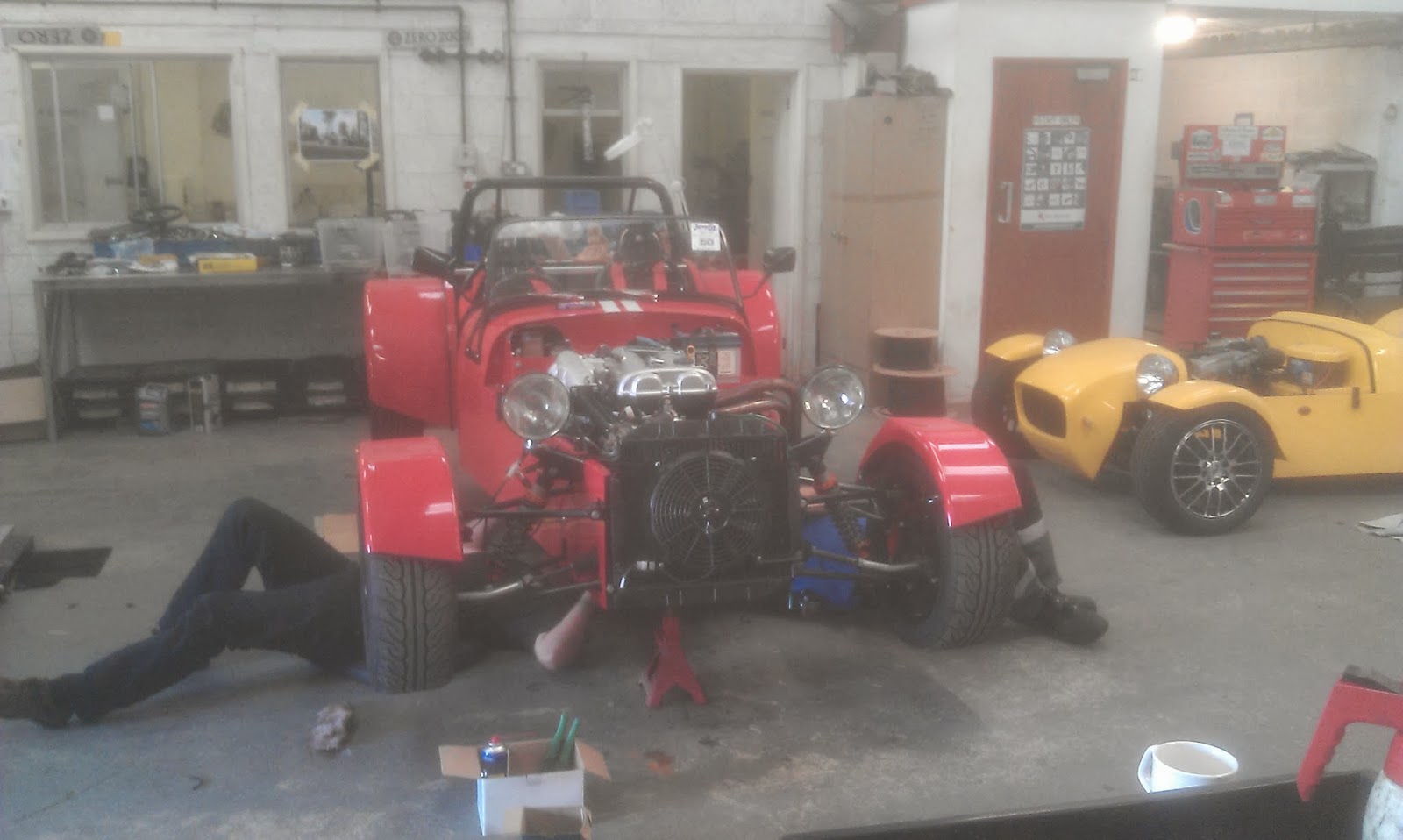
The GBS factory is some three and a half hours drive from my home in Southampton, so last Friday I set out at six in the morning to visit the factory and test drive the (very nearly) finished Mazda based Zero demonstrator car. This is something I have been looking forward to for a long time - a glimpse in to the future of what my car will be like when it's finished.
Arriving at the factory and the first sight of the car wasn't exactly what I had expected or hoped for. It seems that, during a recent track day, someone forgot to administer oil to the gearbox, which lead to the subsequent demise of said gearbox, and a very hot engine. As such the demo car was propped up on stands with the engine and a new gearbox being worked on next to it. I can't fault the GBS team for commitment here, and having said I could have a test drive that day, a test drive was exactly what they were going to provide me with, which meant fixing and refitting the engine and a new gearbox. I busied myself taking pictures of the fuel systems (next job on my car) in the cars in the workshop, and making notes of the positions of various parts and ways to fit them etc. while Keith and Rafael worked on the engine and gearbox.
By lunchtime the engine was back in the car leaving what looked like the fairly simple job of reconnecting the water, fuel and electrics. Should be going in no time... However, a problem with the IAC meant an hour or so with a laptop working on the Emerald ECU. By this time the car was being worked on by 3 people - Richard, Keith, and Rafael, resembling a scene from a pit lane just before the race. Richard even put off another job to get the car running. By mid afternoon the car was back together and filling the workshop with exhaust fumes. Lovely.
On the road and initially it feels very much like the Zetec powered Zero, as you might expect. The exhaust note is slightly higher and the smaller 1.6 liter engine is very responsive when opening up the throttle. The engine is controlled by an Emerald ECU which has recently been tuned on the Emerald rolling road. The acceleration doesn't seem as quick as the Zetec, but it has been a while since I drove it, however just like the Zetec it just keeps accelerating faster and faster.
Cornering is every bit as much fun as I remember. The demonstrator has some specially made brakes, developed by GBS, fitted to the front, which respond instantly and give you the confidence to chuck the car round a roundabout or sharp corner knowing you can have it all back under control with a touch on the pedal. The rear brakes are the standard MX-5.
Along with the engine mapping, I know GBS have been working on the suspension set up. I am no expert but I think this car feels even more solid on the road than the Zetec powered car I drove back in February. I have gone for the slightly cheaper GAZ shocks but one thing I will make sure to do is spend some serious time and effort getting them set up properly.
Another thing I will be doing on my car is fitting some doors! They don't always look right on a seven style sports car, but the buffeting from the wind when only going moderately fast was a bit overpowering.
This was a glimpse in to the future of what my car will hopefully be like if I ever get round to finishing it. If it turns out to be half as much fun to drive as the factory demonstrator, needless to say I will be very happy...
All in all a great experience and one I would recommend anyone thinking of building a kit car go and do as soon as possible. Lastly I must say a massive thank you to GBS for not only letting me loose with the car, but putting it back together in time for me to drive it. Great work guys, no-one can say you don't put the effort in! Thank you.
The GBS factory is some three and a half hours drive from my home in Southampton, so last Friday I set out at six in the morning to visit the factory and test drive the (very nearly) finished Mazda based Zero demonstrator car. This is something I have been looking forward to for a long time - a glimpse in to the future of what my car will be like when it's finished.
Arriving at the factory and the first sight of the car wasn't exactly what I had expected or hoped for. It seems that, during a recent track day, someone forgot to administer oil to the gearbox, which lead to the subsequent demise of said gearbox, and a very hot engine. As such the demo car was propped up on stands with the engine and a new gearbox being worked on next to it. I can't fault the GBS team for commitment here, and having said I could have a test drive that day, a test drive was exactly what they were going to provide me with, which meant fixing and refitting the engine and a new gearbox. I busied myself taking pictures of the fuel systems (next job on my car) in the cars in the workshop, and making notes of the positions of various parts and ways to fit them etc. while Keith and Rafael worked on the engine and gearbox.
By lunchtime the engine was back in the car leaving what looked like the fairly simple job of reconnecting the water, fuel and electrics. Should be going in no time... However, a problem with the IAC meant an hour or so with a laptop working on the Emerald ECU. By this time the car was being worked on by 3 people - Richard, Keith, and Rafael, resembling a scene from a pit lane just before the race. Richard even put off another job to get the car running. By mid afternoon the car was back together and filling the workshop with exhaust fumes. Lovely.
On the road and initially it feels very much like the Zetec powered Zero, as you might expect. The exhaust note is slightly higher and the smaller 1.6 liter engine is very responsive when opening up the throttle. The engine is controlled by an Emerald ECU which has recently been tuned on the Emerald rolling road. The acceleration doesn't seem as quick as the Zetec, but it has been a while since I drove it, however just like the Zetec it just keeps accelerating faster and faster.
Cornering is every bit as much fun as I remember. The demonstrator has some specially made brakes, developed by GBS, fitted to the front, which respond instantly and give you the confidence to chuck the car round a roundabout or sharp corner knowing you can have it all back under control with a touch on the pedal. The rear brakes are the standard MX-5.
Along with the engine mapping, I know GBS have been working on the suspension set up. I am no expert but I think this car feels even more solid on the road than the Zetec powered car I drove back in February. I have gone for the slightly cheaper GAZ shocks but one thing I will make sure to do is spend some serious time and effort getting them set up properly.
Another thing I will be doing on my car is fitting some doors! They don't always look right on a seven style sports car, but the buffeting from the wind when only going moderately fast was a bit overpowering.
This was a glimpse in to the future of what my car will hopefully be like if I ever get round to finishing it. If it turns out to be half as much fun to drive as the factory demonstrator, needless to say I will be very happy...
All in all a great experience and one I would recommend anyone thinking of building a kit car go and do as soon as possible. Lastly I must say a massive thank you to GBS for not only letting me loose with the car, but putting it back together in time for me to drive it. Great work guys, no-one can say you don't put the effort in! Thank you.
Sunday, 29 September 2013
Differential, Brakes, Time to catch up
Again, it's been a long time since my last post. Time for a bit of a catch up.
First part fitted to the chassis is the differential. This thing has taken the longest and been the most painful donor part to de-rust and clean up, so it's with some satisfaction that I now have it attached to the car. I had to drill 3 holes in the top bracket in line with the plate on the chassis. It sits slightly below the mounting plate and needs to be packed out with washers when fitted which made marking the holes tricky. I got it just about right and only needed to file a little bit around each one to make it fit. I may need to look at the underneath of the bracket to ensure there is enough contact between the washers and the bracket for it to be secure. Right now it is solidly on there, but i have noticed that I missed a bit when painting it - no-one could ever see it but I'll know it's there... Do I take it off and re-paint it? Or leave it on and try and forget it? I think I can forget it.
The kit contains all the suspension wishbones and associated bushes and crush tubes. Given my complete ignorance of many mechanical engineering principles prior to the start of the project, I don't mind admitting that I didn't know the real purpose of the crush tubes and had assumed that these should fit tightly in the bushes and the movement was on the bolts. Not so. The crush tubes are there to be 'crushed' into the bracket on the chassis and remain rigid while the nylon bushes rotate around them. It all make perfect sense now of course, thanks to Richard from GBS for pointing it out.
I had spent at least a day putting in all the bushes crush tubes, only to take them out again a couple of weeks later to drill out the bushes so the tubes rotated inside them. They are still a tight fit and you can't turn them by holding them with your fingers, but if they are clamped in a vice they can be seen to stay still while the bush rotates around it. Another lesson learnt, I wonder how many more there are to come.
I don't have enough room in my tiny garage to put all the suspension parts on the car just yet so they are all ready to install when I have the space. the engine and gearbox are taking up a lot of room along one side of the garage so I should think that when I get that installed I will be able to put these parts on.
Further work on the wheel hubs and uprights have now seen them painted nicely in gloss black. I am surprised how well they have come up actually, and they will look good on the car. I tried to fit a wheel bearing - WARNING: a 3 minute video on youtube is not sufficient training to undertake this sort of activity without the help of someone who knows what they are actually doing. I got one rear bearing half in before it stuck solid. I can confirm some colourful language was used at this point, along with several threats to sell everything and move to Australia. However, a local garage has kindly agreed to fix the problem and fit the other bearing properly. Nice people.
Further on and I have started fitting the brake lines. This really signifies the start of the main part of the build and it's good to see some sort of real progress at last. As lines leave the master cylinder and spread out around the chassis, the rear line needs to cross over with the front ones which is only really practical as they enter the tunnel. I have made the routing as neat as I can, but still having them cross there is a little untidy. When they are all secured down I think it should be OK. The clutch cylinder is very close to the brake cylinder so the rear line needs to route around it which makes for some interesting bends. At the recent Donnington kit car show I collared Simon from GBS to talk about how best to go about running brake lines. Turns out the tools I bought to supposedly bend brake lines neatly are not as good as gently forming the bends by hand. I have taken his advise and am very pleased with the result. Many thanks Simon.
I have just put in a big order with Kit Spares so I have shocks, fuel tank, fuel lines and other fuel system components on the way. I also went to the factory on Friday to test drive the factory built Mazda based Zero... Review of that coming in the next day or so, but suffice to say if you are thinking about buying a kit car - get up there and drive it. Your decision will probably make itself.
First part fitted to the chassis is the differential. This thing has taken the longest and been the most painful donor part to de-rust and clean up, so it's with some satisfaction that I now have it attached to the car. I had to drill 3 holes in the top bracket in line with the plate on the chassis. It sits slightly below the mounting plate and needs to be packed out with washers when fitted which made marking the holes tricky. I got it just about right and only needed to file a little bit around each one to make it fit. I may need to look at the underneath of the bracket to ensure there is enough contact between the washers and the bracket for it to be secure. Right now it is solidly on there, but i have noticed that I missed a bit when painting it - no-one could ever see it but I'll know it's there... Do I take it off and re-paint it? Or leave it on and try and forget it? I think I can forget it.
The kit contains all the suspension wishbones and associated bushes and crush tubes. Given my complete ignorance of many mechanical engineering principles prior to the start of the project, I don't mind admitting that I didn't know the real purpose of the crush tubes and had assumed that these should fit tightly in the bushes and the movement was on the bolts. Not so. The crush tubes are there to be 'crushed' into the bracket on the chassis and remain rigid while the nylon bushes rotate around them. It all make perfect sense now of course, thanks to Richard from GBS for pointing it out.
I had spent at least a day putting in all the bushes crush tubes, only to take them out again a couple of weeks later to drill out the bushes so the tubes rotated inside them. They are still a tight fit and you can't turn them by holding them with your fingers, but if they are clamped in a vice they can be seen to stay still while the bush rotates around it. Another lesson learnt, I wonder how many more there are to come.
I don't have enough room in my tiny garage to put all the suspension parts on the car just yet so they are all ready to install when I have the space. the engine and gearbox are taking up a lot of room along one side of the garage so I should think that when I get that installed I will be able to put these parts on.
Further work on the wheel hubs and uprights have now seen them painted nicely in gloss black. I am surprised how well they have come up actually, and they will look good on the car. I tried to fit a wheel bearing - WARNING: a 3 minute video on youtube is not sufficient training to undertake this sort of activity without the help of someone who knows what they are actually doing. I got one rear bearing half in before it stuck solid. I can confirm some colourful language was used at this point, along with several threats to sell everything and move to Australia. However, a local garage has kindly agreed to fix the problem and fit the other bearing properly. Nice people.
Further on and I have started fitting the brake lines. This really signifies the start of the main part of the build and it's good to see some sort of real progress at last. As lines leave the master cylinder and spread out around the chassis, the rear line needs to cross over with the front ones which is only really practical as they enter the tunnel. I have made the routing as neat as I can, but still having them cross there is a little untidy. When they are all secured down I think it should be OK. The clutch cylinder is very close to the brake cylinder so the rear line needs to route around it which makes for some interesting bends. At the recent Donnington kit car show I collared Simon from GBS to talk about how best to go about running brake lines. Turns out the tools I bought to supposedly bend brake lines neatly are not as good as gently forming the bends by hand. I have taken his advise and am very pleased with the result. Many thanks Simon.
I have just put in a big order with Kit Spares so I have shocks, fuel tank, fuel lines and other fuel system components on the way. I also went to the factory on Friday to test drive the factory built Mazda based Zero... Review of that coming in the next day or so, but suffice to say if you are thinking about buying a kit car - get up there and drive it. Your decision will probably make itself.
Sunday, 11 August 2013
Getting my kit together
Again, another huge gap between posts. The past month has seen me pick up my kit, starting to put it together, working out what more parts I need, and of course buying more tools.
In recent posts I have been cleaning up and painting the Mazda parts. I have now completed the gearbox and steering / suspension parts, as well as making a start on the engine. I have a new clutch to fit which is best done with the engine and gearbox out of the car. With the impending arrival of the kit a massive tidy up operation (not my favorite activity) needed to be undertaken to ensure the chassis would fit. I think I have overdone my tool buying slightly and will probably need to find alternative storage for things like the shotblasting cabinet and air compressor. I have also sorted the remains of the Mazda in to parts I will need, parts I can sell, and parts I will chuck out.
So, lets get something to work on...
The GBS factory is some 200 miles from my home in Southampton so an early morning was called for getting me there at about 08:30 in my hired Transit. The first van I was offered by the hire company had a faulty door catch so I had to take a different slightly shorter one, causing a little worry that the chassis might not fit. Luckily it did but, to be fair, only just. I then captured Keith and Richard at GBS and quizzed them on every aspect of the factory car I could think of. They have almost completed their Mazda demonstrator which we spent some time pouring over. Just so we know what we are working towards here, here are some pictures:
A slight disappointment in that the headlight cases and front upper wishbones were missing from the kit of parts, but GBS will send them on when they are ready. I'm sure I will have enough to work on so I won't miss them yet. GBS are going to modify the prop, drive and steering shafts and send them on to me as well.
Back home and with the chassis moved to my tiny garage, and all the other parts scattered around my flat, I set to work getting to know what I had to work with. Along with the chassis and wishbones, the kit includes the nylon bushes and crush tubes, and the relevant bolts and nuts to fit them together, pedals and associated fixings, lights, and of course all the body panels.
My plan to start off the build is roughly as follows:
Fit the differential
Fit the wishbones and shocks
Fit new bearings and bushes in the rear uprights and fit them
Fit pedals and master cylinders
Install brake pipes
With everything accounted for I set to work on the differential. I have cut off the old mouthing lugs but need to drill 3 holes in the top mouthing bracket. The diff is mostly made of cast iron so it is not easy to lift up to the chassis to locate the holes. I managed to do it by positioning it on an old box and progressively adding more bits of wood underneath it to lever it up high enough. It fits nicely but I have yet to drill the holes.
Wishbones next. Inserting the nylon bushes and crush tubes was first. Bear in mind that I have not done anything like this before so I was glad to find Richard Lincoln's blog with a detailed explanation of how to do it. A bit of Copper Ease and the bench vice and I soon had the hang of it. I just needed to spend time on each one being very careful to ensure the bushes went in precisely square so not to deform them or shave off any nylon. I now need to fit the new bushes and wheel bearings in to the rear uprights and order the shock absorbers.
One aborted attempt to fit a rear wheel bearing has convinced me that this bit is difficult and I will seek advice before continuing. The new wheel bearings cost over £35 each so I don't want to trash any unnecessarily.
Looking at what I have done and the time I have had to do it in, there doesn't seem to have been much progress made. I will wheel out the excuse of a few foreign business trips taking up the time... I will have more to report soon.
In recent posts I have been cleaning up and painting the Mazda parts. I have now completed the gearbox and steering / suspension parts, as well as making a start on the engine. I have a new clutch to fit which is best done with the engine and gearbox out of the car. With the impending arrival of the kit a massive tidy up operation (not my favorite activity) needed to be undertaken to ensure the chassis would fit. I think I have overdone my tool buying slightly and will probably need to find alternative storage for things like the shotblasting cabinet and air compressor. I have also sorted the remains of the Mazda in to parts I will need, parts I can sell, and parts I will chuck out.
So, lets get something to work on...
The GBS factory is some 200 miles from my home in Southampton so an early morning was called for getting me there at about 08:30 in my hired Transit. The first van I was offered by the hire company had a faulty door catch so I had to take a different slightly shorter one, causing a little worry that the chassis might not fit. Luckily it did but, to be fair, only just. I then captured Keith and Richard at GBS and quizzed them on every aspect of the factory car I could think of. They have almost completed their Mazda demonstrator which we spent some time pouring over. Just so we know what we are working towards here, here are some pictures:
A slight disappointment in that the headlight cases and front upper wishbones were missing from the kit of parts, but GBS will send them on when they are ready. I'm sure I will have enough to work on so I won't miss them yet. GBS are going to modify the prop, drive and steering shafts and send them on to me as well.
Back home and with the chassis moved to my tiny garage, and all the other parts scattered around my flat, I set to work getting to know what I had to work with. Along with the chassis and wishbones, the kit includes the nylon bushes and crush tubes, and the relevant bolts and nuts to fit them together, pedals and associated fixings, lights, and of course all the body panels.
My plan to start off the build is roughly as follows:
Fit the differential
Fit the wishbones and shocks
Fit new bearings and bushes in the rear uprights and fit them
Fit pedals and master cylinders
Install brake pipes
With everything accounted for I set to work on the differential. I have cut off the old mouthing lugs but need to drill 3 holes in the top mouthing bracket. The diff is mostly made of cast iron so it is not easy to lift up to the chassis to locate the holes. I managed to do it by positioning it on an old box and progressively adding more bits of wood underneath it to lever it up high enough. It fits nicely but I have yet to drill the holes.
Wishbones next. Inserting the nylon bushes and crush tubes was first. Bear in mind that I have not done anything like this before so I was glad to find Richard Lincoln's blog with a detailed explanation of how to do it. A bit of Copper Ease and the bench vice and I soon had the hang of it. I just needed to spend time on each one being very careful to ensure the bushes went in precisely square so not to deform them or shave off any nylon. I now need to fit the new bushes and wheel bearings in to the rear uprights and order the shock absorbers.
One aborted attempt to fit a rear wheel bearing has convinced me that this bit is difficult and I will seek advice before continuing. The new wheel bearings cost over £35 each so I don't want to trash any unnecessarily.
Looking at what I have done and the time I have had to do it in, there doesn't seem to have been much progress made. I will wheel out the excuse of a few foreign business trips taking up the time... I will have more to report soon.
Sunday, 14 July 2013
Getting on with it
It's been a while since my last post on this site. The past month has seen a fair bit of work on the car (bits for it anyway), interspersed with a few foreign business trips, and nearly being made redundant from my day job. I am pleased to say that I am still gainfully employed and as such can continue to feed what is becoming a dangerously addictive habit of buying increasingly expensive tools.
The first task after getting all the parts from the Mazda back to my tiny garage was to de-rust, clean, and paint the bits I will need to attach to the kit. The menu included the differential, gearbox, hubs and brackets, and brake calipers. Prop and drive shafts need to be shortened so will be addressed when I have the chassis. I'm probably going to just clean the remains of the dirt and oil off the engine and scrub the rocker cover to make it look a little nicer. I have no desire at this stage to strip the engine down and rebuild it.
The differential was the worst affected by corrosion (see the picture on the previous post). I tried the usual wire brush and wire wheel attack but it was only really polishing the rust layer. Some rust remover chemicals were employed which were, and I'll be completely honest here, USELESS. Probably not designed for such serious corrosion. The purchase of a wire 'cup' for the angle grinder was the most effective. If I added up all the hours spent working on the diff it would run in to days of work, probably more, however it's now mostly done and looking good. I need to remove the mounting lugs and paint it.
Next up - Gearbox. Being made of alloy there was no rust but there was a bit of surface corrosion and a lot of dirt and oil to clean off. The most effective tools here were cellulose thinners and synthetic wire wool. One new tool this month was a bench grinder with a large wire wheel attachment. I removed most of the bolts in the gearbox one at a time and cleaned them on the wire wheel. The result made the finished article look almost new. I am almost impressed with what I have achieved with this, however I must give most of the credit to my brother who kindly gave up a weekend to help push the project along in return for curry and beer.
There are a few hard to reach corners that haven't cleaned completely but I have to draw a line somewhere as I seem to have been cleaning the diff and box forever. Yet to be painted, the gearbox has come up well overall.
I've mentioned previously that the underside of the Mazda had suffered badly from rust. This included the wheel hubs and brake calipers. Having spent enough time on the differential, I had no intention of trying to clean up the hubs with a wire brush - however mechanically assisted - so it looked like the best option was to remove the bearings and shot blast the parts. What I should have done at this point was find a local shotblasting place and taken everything to them. What I actually did was use this as an excuse to buy myself an air compressor and shotblasting cabinet, and clean the parts myself.
Don't get me wrong, I am pleased with my purchase. It has got the rust off the parts, provided a talking point at work, and most of all I have some cool new tools. But, and I don't say this lightly, I actually wish I hadn't bothered. Although the cabinet is sealed with filters to let the air out and keep the grit inside, the seals can't quite cope with the pressure of the air compressor at full blast, particularly if the filters are a little blocked, and a certain amount of very fine dust is forced through. With some of the parts taking several hours to fully clean (there was a lot of rust and I am a bit of a perfectionist), and a lot of parts to do, I would end a session covered in dust, and a layer of the stuff gathering over everything in the garage. It also used so much air that the compressor was on nearly all the time. Not only was it dusty and noisy, I had to do it all with the garage door shut so not to upset the neighbors, so it was also very hot work.
If I had known all this before, I probably wouldn't have bought it. Having said that, the parts have been cleaned really well and now have a primer on them ready to to be painted which I shall do in the next week or so.
Talking of painting, The gearbox is now primed and awaiting its final coat.
And finally... I have just heard that my kit is now ready to pick up from the factory. I shall be hiring a van and driving to the East Midlands on Tuesday.
The first task after getting all the parts from the Mazda back to my tiny garage was to de-rust, clean, and paint the bits I will need to attach to the kit. The menu included the differential, gearbox, hubs and brackets, and brake calipers. Prop and drive shafts need to be shortened so will be addressed when I have the chassis. I'm probably going to just clean the remains of the dirt and oil off the engine and scrub the rocker cover to make it look a little nicer. I have no desire at this stage to strip the engine down and rebuild it.
The differential was the worst affected by corrosion (see the picture on the previous post). I tried the usual wire brush and wire wheel attack but it was only really polishing the rust layer. Some rust remover chemicals were employed which were, and I'll be completely honest here, USELESS. Probably not designed for such serious corrosion. The purchase of a wire 'cup' for the angle grinder was the most effective. If I added up all the hours spent working on the diff it would run in to days of work, probably more, however it's now mostly done and looking good. I need to remove the mounting lugs and paint it.
Next up - Gearbox. Being made of alloy there was no rust but there was a bit of surface corrosion and a lot of dirt and oil to clean off. The most effective tools here were cellulose thinners and synthetic wire wool. One new tool this month was a bench grinder with a large wire wheel attachment. I removed most of the bolts in the gearbox one at a time and cleaned them on the wire wheel. The result made the finished article look almost new. I am almost impressed with what I have achieved with this, however I must give most of the credit to my brother who kindly gave up a weekend to help push the project along in return for curry and beer.
There are a few hard to reach corners that haven't cleaned completely but I have to draw a line somewhere as I seem to have been cleaning the diff and box forever. Yet to be painted, the gearbox has come up well overall.
I've mentioned previously that the underside of the Mazda had suffered badly from rust. This included the wheel hubs and brake calipers. Having spent enough time on the differential, I had no intention of trying to clean up the hubs with a wire brush - however mechanically assisted - so it looked like the best option was to remove the bearings and shot blast the parts. What I should have done at this point was find a local shotblasting place and taken everything to them. What I actually did was use this as an excuse to buy myself an air compressor and shotblasting cabinet, and clean the parts myself.
Don't get me wrong, I am pleased with my purchase. It has got the rust off the parts, provided a talking point at work, and most of all I have some cool new tools. But, and I don't say this lightly, I actually wish I hadn't bothered. Although the cabinet is sealed with filters to let the air out and keep the grit inside, the seals can't quite cope with the pressure of the air compressor at full blast, particularly if the filters are a little blocked, and a certain amount of very fine dust is forced through. With some of the parts taking several hours to fully clean (there was a lot of rust and I am a bit of a perfectionist), and a lot of parts to do, I would end a session covered in dust, and a layer of the stuff gathering over everything in the garage. It also used so much air that the compressor was on nearly all the time. Not only was it dusty and noisy, I had to do it all with the garage door shut so not to upset the neighbors, so it was also very hot work.
If I had known all this before, I probably wouldn't have bought it. Having said that, the parts have been cleaned really well and now have a primer on them ready to to be painted which I shall do in the next week or so.
Talking of painting, The gearbox is now primed and awaiting its final coat.
And finally... I have just heard that my kit is now ready to pick up from the factory. I shall be hiring a van and driving to the East Midlands on Tuesday.
Subscribe to:
Comments (Atom)


